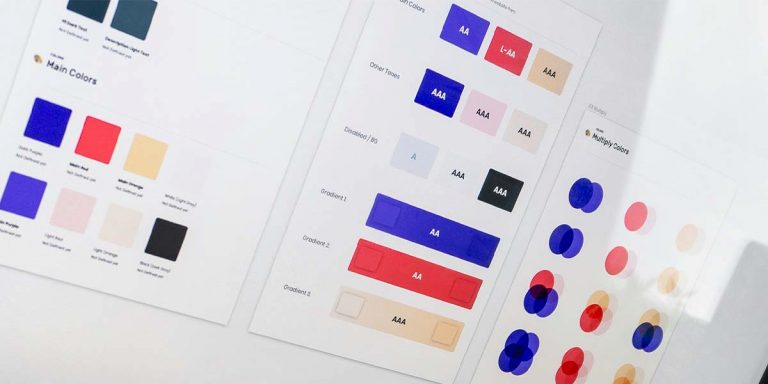
Our work is guided by three principles: Accessibility, Inclusivity and Sustainability.
But how do we achieve this in practice? What systems do we have in place to measure ourselves against these goals? We’ll break down some of the steps we are taking to ensure our projects deliver on these principles; this time, inclusivity.
The difference between inclusivity and accessibility
Inclusivity and accessibility are often used interchangeably when talking about design processes, but there are key differences between the two.
While accessible design typically focuses on the end result and can often be measured against certain criteria, inclusive design and communications is a broader process, that takes into account the needs and lived experience of users throughout the project. Accessibility in communications is generally referred to as relating to those with a disability (be it cognitive, visual, physical, or auditory), whereas inclusivity focuses on making products and experiences available for everyone. Good accessible design is therefore often an outcome of good inclusive design.
Stakeholder involvement
From the outset, we ensure all stakeholders have the opportunity to input their needs and targets for the project. A number of organisations we work with have significant cultural diversity and extreme differences in life experiences of their audiences, staff bodies and beneficiaries. We listen to these diverse perspectives to gain a holistic view of the aims for the outcome of the project.
We like to work with our clients as if we were an in-house team. This means that at each step of the way we are sharing concepts, sharing messaging frameworks and spending as long as it takes to ensure every stakeholder working on the project is feels heard, and is delighted with the direction we are heading in.
Inclusive language
Our team of copywriters work to ensure that content we produce:
- Avoids gendered language, including binary terms (such as ladies and gentlemen)
- Avoids the use of regional phrases and cultural references that can exclude people based on age or geography
- Uses preferred choices when referring to different ethnicities, genders and disabilities
Sensitive storytelling
Storytelling is powerful and never more so when you work, as we do, with mission-driven organisations. The deep sense of connection and empathy you can convey through telling someone’s story, both visually and through narrative, is a privilege to be able to work with, and we are continuously listening and adapting to ensure our portrayals are both authentic and sensitive to the subject.
Continuous learning
Though we pride ourselves on our commitment to inclusivity, we are conscious that there is always more we can learn and do to help everyone feel included. Our team is continuously learning, and drawing upon the experience of our wider global team to better understand how we can improve.
In Summary
Incorporating inclusivity throughout our projects helps us to ensure our projects are respectful, accurate and accessible to all – enabling everyone to contribute their perspectives and feel like they belong. We are constantly learning, and challenging ourselves to better understand the needs and perspectives for those we are designing for.

I'm a multi-disciplinary designer, with many years of experience designing graphics with impact and seamless user experiences. I started my career designing consumer products, but have since worked on a diverse range of projects from leading brand refresh projects for charities like Sculpt, Jamma and TUSP, sustainable and user-friendly website re-designs for CTRF, Climate Change Coaches and Mokoro to large internal communication projects for WWF and Oxford HR. I'm passionate about the use of design as a tool for positive social change, and with particular interest in projects tackling racial inequality and children’s social care. Recently I was appointed as a Trustee for the new charity Board Racial Diversity UK, working to improve representation within the UK charity sector.